



Larynx anatomy
Also known as: voice box, vocal cords
The voice box: a cartilage frame with the vocal ligaments, guarding the airway and producing sound.
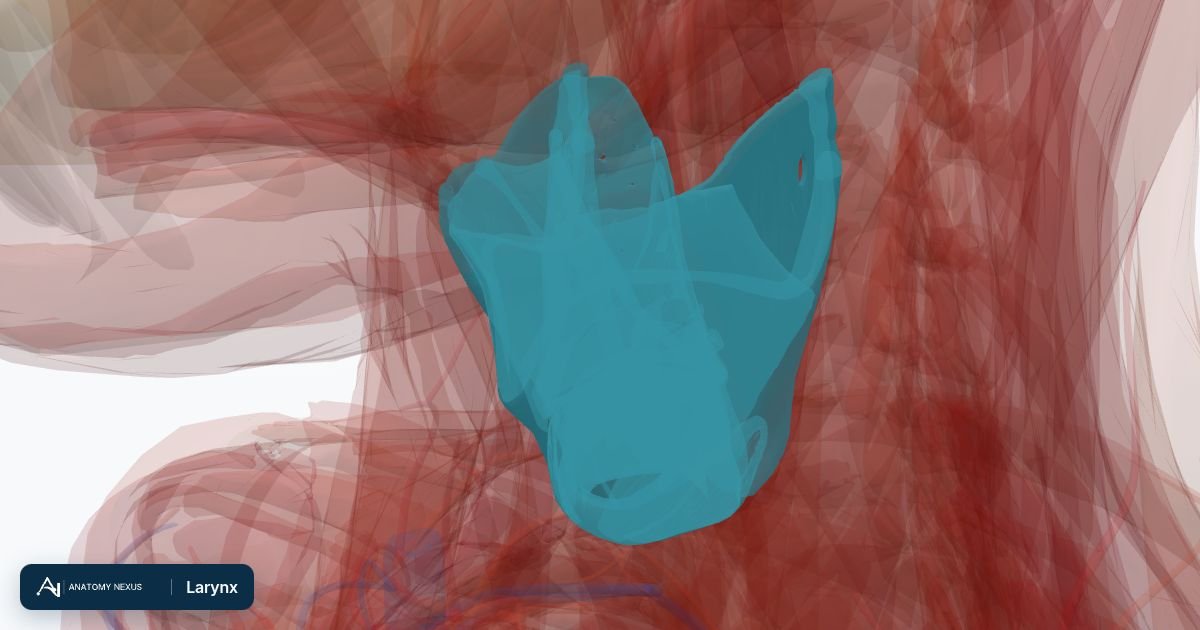
Structures in the atlas 40
The modelled pieces that make up the larynx in the 3D atlas. Each opens in the explorer.
- Cricoid cartilage · 2 pieces
- Epiglottis
- Hyo-epiglottic ligament
- Left aryepiglotticus
- Left arytenoid cartilage
- Left conus elasticus
- Left corniculate cartilage
- Left cuneiform cartilage
- Left lateral crico-arytenoid
- Left lateral thyrohyoid ligament
- Left oblique arytenoid
- Left posterior crico-arytenoid
- Left thyro-arytenoid · 2 pieces
- Left thyrohyoid
- Left thyrohyoid membrane
- Left vocal ligament
- Left vocalis
- Median cricothyroid ligament
- Median thyrohyoid ligament
- Oblique part of left cricothyroid
- Oblique part of right cricothyroid
- Right aryepiglotticus
- Right arytenoid cartilage
- Right conus elasticus
- Right corniculate cartilage
- Right cuneiform cartilage
- Right lateral crico-arytenoid
- Right lateral thyrohyoid ligament
- Right oblique arytenoid
- Right posterior crico-arytenoid
- Right thyro-arytenoid · 2 pieces
- Right thyrohyoid
- Right thyrohyoid membrane
- Right vocal ligament
- Right vocalis
- Straight part of left cricothyroid
- Straight part of right cricothyroid
- Thyro-epiglottic ligament
- Thyroid cartilage
- Transverse arytenoid
The respiratory in brief
Air enters through the nose, where cartilages support the nostrils and conchae warm and moisten it, passes the larynx, which guards the airway and produces the voice, and descends the trachea. The trachea divides into the main bronchi, which branch again and again into the segmental bronchial trees modelled here, one for each bronchopulmonary segment. Gas exchange takes place in the alveoli at the end of this tree; the lung tissue itself is not a separate piece in this dataset, so the bronchial trees stand in for the lungs.