



Rib cage anatomy
Also known as: ribs, rib cage, chest, sternum, breastbone
Twelve pairs of ribs, their costal cartilages and the sternum protect the heart and lungs and move with breathing.
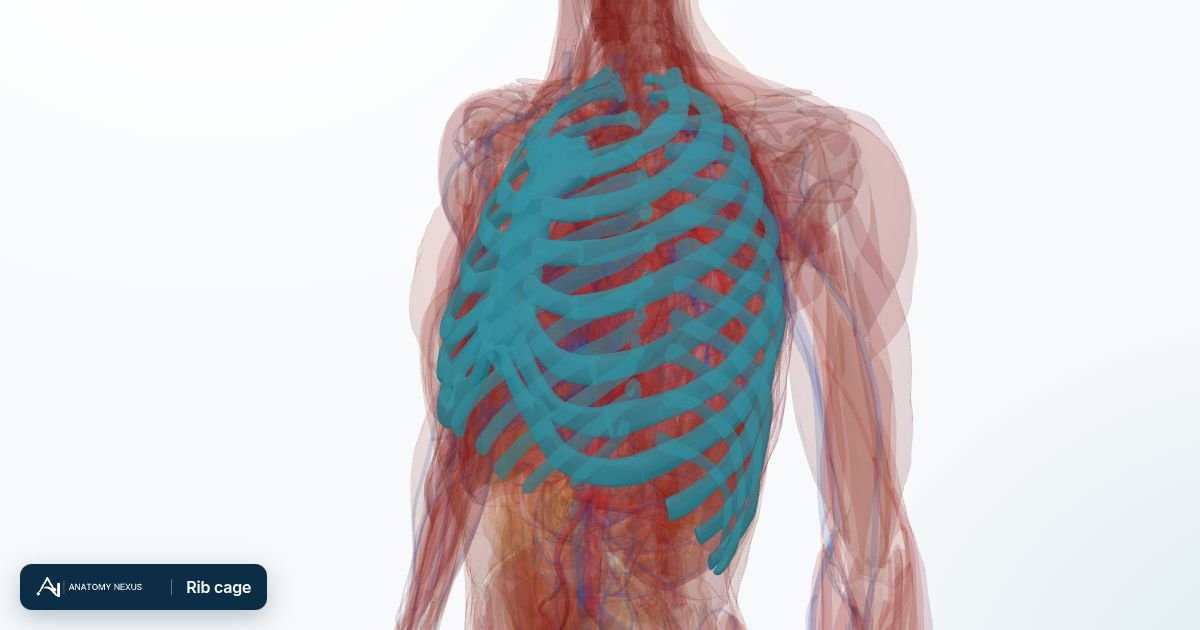
Structures in the atlas 41
The modelled pieces that make up the rib cage in the 3D atlas. Each opens in the explorer.
- Body of sternum
- Left eighth rib
- Left eleventh rib
- Left fifth costal cartilage
- Left fifth rib
- Left first costal cartilage
- Left first rib
- Left fourth costal cartilage
- Left fourth rib
- Left ninth rib
- Left second costal cartilage
- Left second rib
- Left seventh costal cartilage
- Left seventh rib
- Left sixth costal cartilage
- Left sixth rib
- Left tenth rib
- Left third costal cartilage
- Left third rib
- Left twelfth rib
- Manubrium
- Right eighth rib
- Right eleventh rib
- Right fifth costal cartilage
- Right fifth rib
- Right first costal cartilage
- Right first rib
- Right fourth costal cartilage
- Right fourth rib
- Right ninth rib
- Right second costal cartilage
- Right second rib
- Right seventh costal cartilage
- Right seventh rib
- Right sixth costal cartilage
- Right sixth rib
- Right tenth rib
- Right third costal cartilage
- Right third rib
- Right twelfth rib
- Xiphoid process
The skeleton in brief
The adult skeleton has 206 bones plus the cartilages that cap joints, join the ribs to the sternum and shape the nose and airway. It is organised into an axial skeleton (skull, vertebral column, ribs and sternum) that protects the brain, spinal cord, heart and lungs, and an appendicular skeleton (the limbs with their girdles) built for movement. Bone is living tissue: it remodels throughout life in response to load, stores calcium and phosphate, and houses the marrow that makes blood cells.