



Kidney Anatomy
Also known as: kidney, renal
The two kidneys are bean-shaped organs the size of a fist, lying against the back wall of the abdomen on either side of the spine. Each contains about a million nephrons that filter the entire blood volume some sixty times a day, keeping water, salts and acid in balance and clearing waste into the urine.
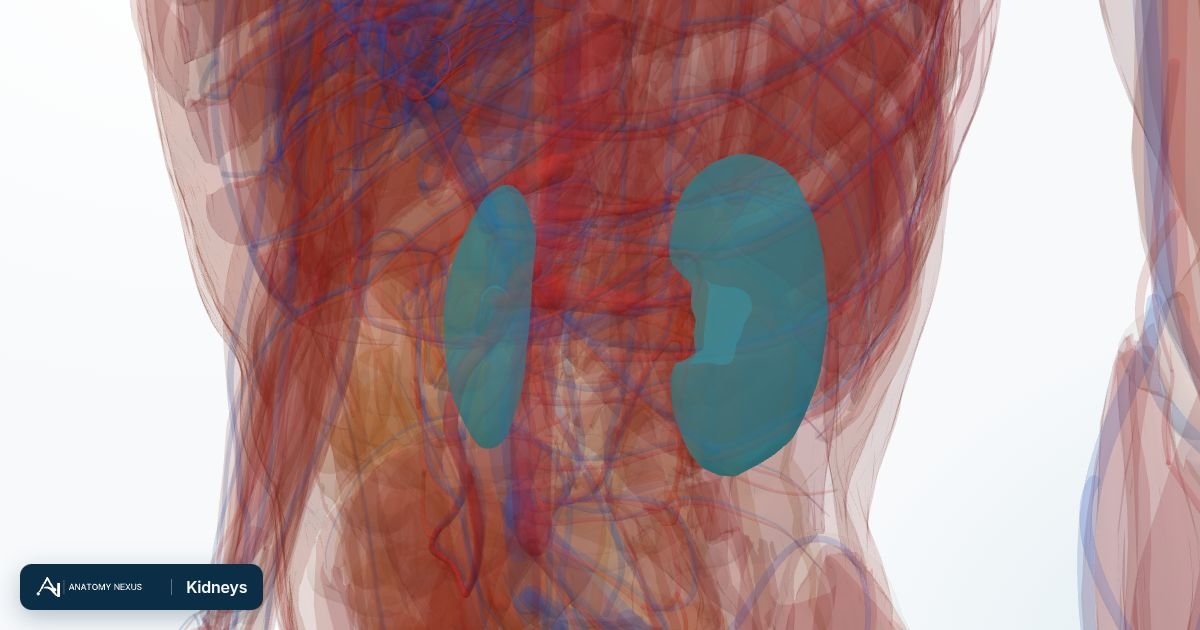
Key facts
| Location | Retroperitoneal, T12-L3, the right kidney slightly lower because of the liver |
|---|---|
| Size | About 11 cm long, 150 g each |
| Working units | About one million nephrons per kidney |
| Blood flow | Around 1.2 L/min, a fifth of cardiac output |
| Filtration | About 180 L of filtrate a day, 99% reabsorbed |
| Hormones | Renin, erythropoietin, active vitamin D |
Location and coverings
The kidneys lie behind the peritoneum against the psoas and quadratus lumborum muscles, the upper poles tucked under the eleventh and twelfth ribs, with the adrenal gland capping each. A tough fibrous capsule, a layer of perirenal fat and the renal fascia hold them in place and cushion them. Because they sit so far back, kidney pain is felt in the loin and can be tested by tapping the renal angle between the last rib and the spine.
Internal structure
A cut kidney shows an outer cortex and inner medulla arranged as renal pyramids, whose tips (papillae) drip urine into cup-shaped minor calyces. These join into major calyces and then the renal pelvis, the funnel that narrows into the ureter at the hilum, where the renal artery enters and the renal vein leaves. Stones formed in the calyces cause agonising pain as they pass into the ureter.
The nephron
Each nephron begins with a glomerulus, a tuft of capillaries inside Bowman's capsule, where blood pressure forces water and small solutes through a filter that holds back cells and proteins. The filtrate then passes along the proximal tubule (bulk reabsorption of water, glucose, salts), the loop of Henle dipping into the medulla (creating the salt gradient that lets urine be concentrated), the distal tubule and the collecting duct, where hormones fine-tune how much water and salt is returned to the blood. Diuretics such as furosemide act on the loop; ACE inhibitors lower the pressure in the glomerulus.
Blood supply
Each renal artery arises directly from the abdominal aorta and divides into segmental, interlobar, arcuate and interlobular arteries before feeding the glomeruli through afferent arterioles. Blood leaves the glomerulus by an efferent arteriole into a second capillary network around the tubules, then into the renal vein and inferior vena cava. Narrowing of a renal artery drives up blood pressure through renin release.
Innervation
Sympathetic nerves from the renal plexus constrict the renal vessels and stimulate renin; there is little parasympathetic supply. Pain from a stone is carried with the sympathetic fibres to spinal segments T11-L2 and referred along the loin, groin and, in men, the testis.
Function
The kidneys hold the composition of the blood steady: they excrete urea, creatinine and drugs, regulate sodium, potassium, calcium and phosphate, correct acid-base balance by excreting acid and regenerating bicarbonate, and adjust water excretion under antidiuretic hormone so that blood concentration stays within one or two per cent. They release renin to control blood pressure, erythropoietin to drive red cell production, and activate vitamin D for the bones.
Clinical relevance
Diabetes and high blood pressure slowly damage the glomeruli, leaking protein into the urine and lowering the filtration rate: chronic kidney disease. Sudden injury from dehydration, sepsis or drugs shows as a rising creatinine. Stones, infection and obstruction affect the collecting system. When function falls below about a tenth, dialysis or a transplant replaces the filtering.
Structures in the atlas 2
The modelled pieces that make up the kidneys in the 3D atlas. Each opens in the explorer.
The urinary in brief
The two kidneys filter about 180 litres of plasma a day, returning almost all of it to the blood and excreting the rest as urine. Urine drains through the ureters into the bladder, a muscular reservoir that empties through the urethra. The kidneys also regulate blood pressure, red cell production and vitamin D activation.