



Digestive
Mouth, pharynx, oesophagus, stomach, intestines, liver, pancreas.
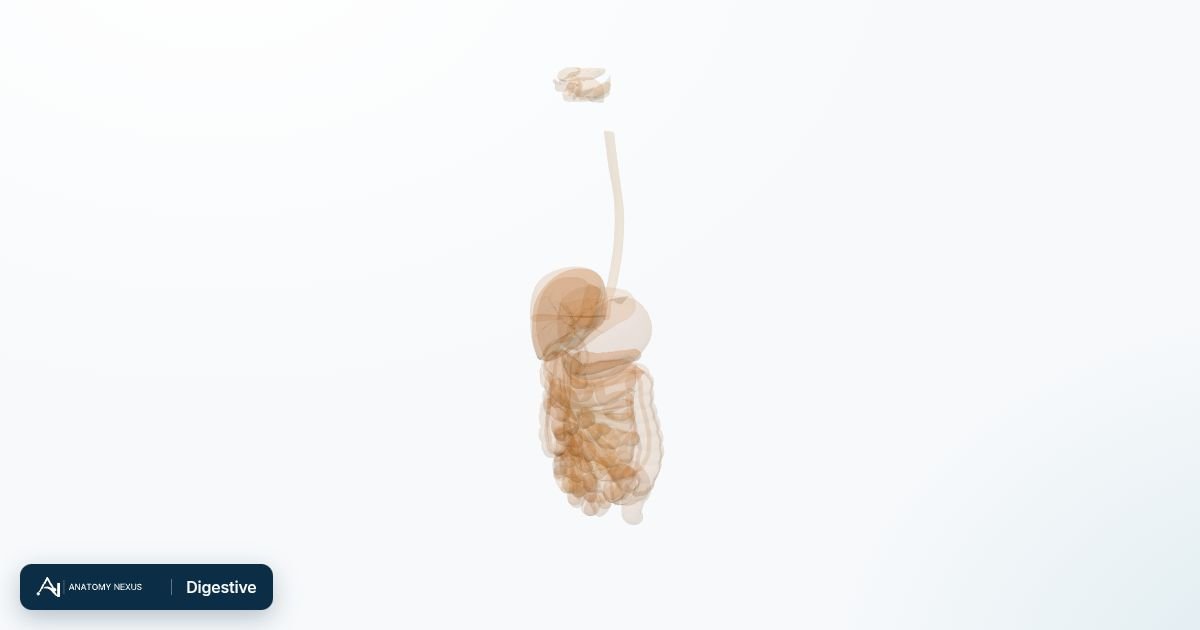
Overview
The digestive tract is a nine-metre tube from mouth to anus. Food is chewed, swallowed down the oesophagus, churned with acid in the stomach, digested and absorbed along the small intestine (duodenum, jejunum, ileum), and its residue concentrated in the colon. The liver, gallbladder and pancreas pour bile and enzymes into the duodenum. The model includes the tongue, salivary glands and gums, the stomach and intestines in many segments, the liver as eight hepatovenous segments with its bile ducts, the gallbladder, the pancreas and the mesenteries that suspend the gut.
Functions
- Break food down mechanically and chemically
- Absorb nutrients and water
- Store and release energy (liver)
- Eliminate waste
Clinical notes
- Reflux, gastritis and peptic ulcers
- Appendicitis, inflammatory bowel disease and colorectal cancer
- Gallstones, hepatitis and pancreatitis
Organs & groups in this system
Tongue
A muscular organ for taste, chewing, swallowing and speech.
Oesophagus
A muscular tube carrying swallowed food from the pharynx to the stomach.
Stomach
A muscular bag that churns food with acid and enzymes before releasing it into the duodenum.
Small intestine
Duodenum, jejunum and ileum: about six metres where most digestion and absorption happens.
Large intestine
Caecum, appendix, colon and rectum absorb water and form stool.
Liver
The body's chemical factory: it processes nutrients, detoxifies blood and makes bile. Modelled as eight hepatovenous segments with the biliary tree.
Gallbladder & bile ducts
Stores and concentrates bile, releasing it into the duodenum through the cystic and common bile ducts.
Pancreas
Makes digestive enzymes and the hormones insulin and glucagon.
All structures 57
109 modelled pieces. Click a structure to open it in the atlas.
- Anterior inferior tributary of right hepatic biliary tree
- Anterior superior tributary of right hepatic biliary tree
- Appendix
- Ascending colon
- Caudate lobe of liver
- Caudate lobe tributary of left hepatic biliary tree
- Common hepatic duct
- Cystic duct
- Descending colon
- Distal part of ileum · 11 pieces
- Distal part of jejunum · 10 pieces
- Duodenum
- Esophagus
- Gallbladder
- Gingiva of lower jaw
- Gingiva of upper jaw
- Hepatovenous segment II
- Hepatovenous segment III
- Hepatovenous segment IV
- Hepatovenous segment IX
- Hepatovenous segment V
- Hepatovenous segment VI
- Hepatovenous segment VII
- Hepatovenous segment VIII · 2 pieces
- Ileocecal junction
- Lateral inferior tributary of left hepatic biliary tree
- Lateral superior tributary of left hepatic biliary tree · 2 pieces
- Left duct of caudate lobe of liver
- Left hepatic duct
- Left sublingual gland
- Left submandibular gland
- Lip
- Medial inferior tributary of left hepatic biliary tree
- Medial superior tributary of left hepatic biliary tree · 2 pieces
- Mesentery of small intestine
- Mesoappendix
- Middle part of ileum · 10 pieces
- Middle part of jejunum · 5 pieces
- Pancreas
- Pancreatic duct
- Pancreatic duct tree
- Parenchyma of pancreas
- Posterior inferior tributary of right hepatic biliary tree
- Posterior superior tributary of right hepatic biliary tree · 2 pieces
- Proximal part of ileum · 10 pieces
- Proximal part of jejunum · 8 pieces
- Rectum
- Right hepatic duct
- Right sublingual gland
- Right submandibular gland
- Stomach
- Taenia libera
- Taenia mesocolica
- Taenia omentalis
- Tongue
- Transverse colon
- Transverse mesocolon